"Who is a foreigner?”
The one who does not belong to the group, who is not "one of them", the other. The foreigner, as it has often been noted, can only be defined in negative fashion. Negative with respect to what? The other of what group?"
"[...]the foreigner is the other of the family, the clan, the tribe. At first, he blends with the enemy. External to my religion, too, he could have been the heathen, the heretic. Not having made an oath of fealty to my lord, he was born on another land, foreign to the kingdom or the empire."
"The foreigner was defined mainly according to two legal system: jus soli and jus sanguinis, the law according to soil and the law according to blood."
"With the establishment of nation-states we come to the only modern, acceptable, and clear definition of foreignness: the foreigner is the one who does not belong to the state in which we are, the one who does not have the same nationality."
(Strangers to Ourselves, Julia Kristeva)
Melbourne is well-known for its multiculturalism, however, for some groups of people, the sense of home was still hard to establish. They do not belong to the group, born in anther land, and blend with the others.
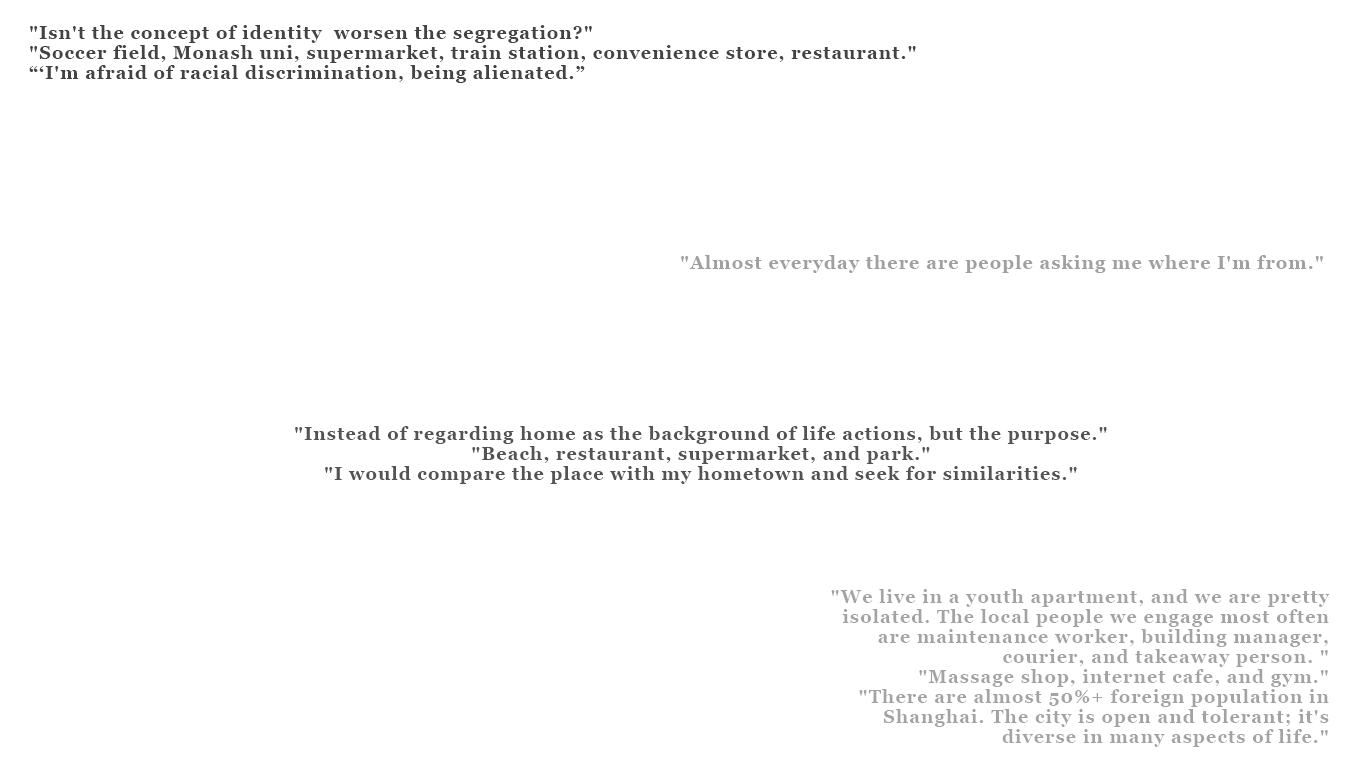
As an international student myself, and with some questions in mind, I had several talks with my friends, who live away from home, and study in Melbourne, NYC, Macau, and Shanghai: How does it feel to live away from home? What are the living conditions? And what are the places they visit the most often in the city?
After the interview, not surprisingly, I realized my friends all lived in different degrees of isolation, in both physical and social aspects. However, public life is not fully absent from their lives. Their social comfort zone starts from their apartments and expands to university campuses, public amenities, and local enterprises. But how come the contact remains at a superficial level? Why do belongingness and the sense of home still hard to gain?